
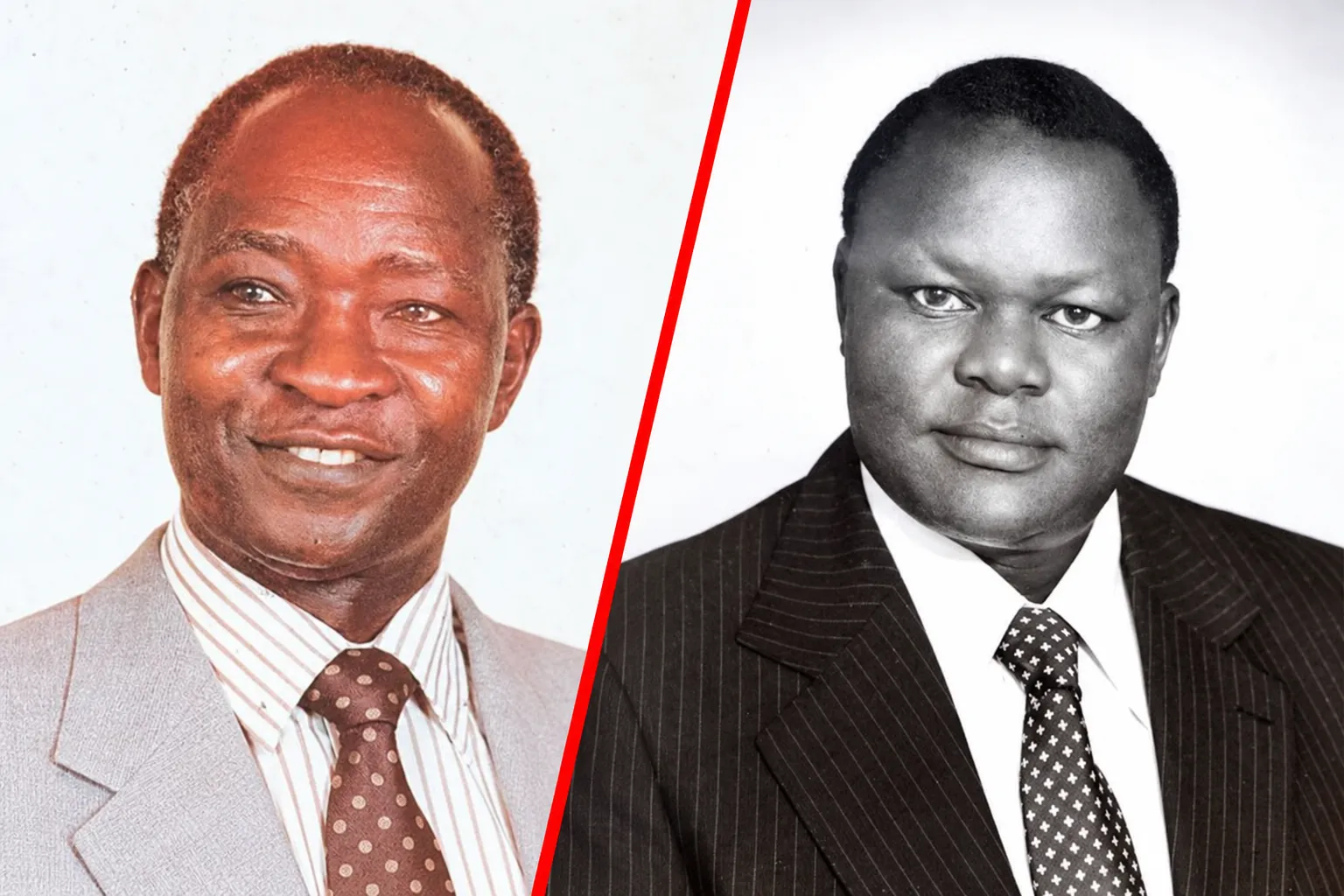
In the political history of Bunyala, few rivalries appear to have carried the emotional weight of the contest between Peter Habenga Okondo and James Charles Nakhwanga Osogo.
It was not merely a contest between two politicians seeking the same parliamentary seat.
It became, according to accounts passed down through the community, a struggle over political influence, education, social standing, family loyalties and the competing identities of different sections of Bunyala.
At the centre of the story was an apparently innocuous question: Could a primary-school teacher really challenge a highly educated politician for Parliament?
One widely circulated recollection attributes a particularly sharp response to Okondo after he learnt that Osogo intended to challenge him at the ballot.
“Mwalimu Osogo apara mbwe ibunge balomalomanga Lunyala?”
The rough sense of the remark was: Does Teacher Osogo think parliamentary debates are conducted in Lunyala?
The story goes further. Okondo allegedly suggested that Osogo should instead ask him for a scholarship to study overseas and improve his English until it was as sharp as a rooster's spur.
Whether the exact words were preserved accurately over the decades is another question. Oral political history is rarely transmitted like a court transcript. Stories acquire embellishments, phrases are polished and personalities become larger than life.
But the significance of the story lies less in the exact wording than in what it represented.
Okondo was confronting Osogo on the battlefield of education and intellectual authority.
And Osogo was preparing to confront him where academic qualifications ultimately could not decide the matter—the ballot box.
EDUCATION AS A POLITICAL WEAPON
According to the historical account attributed to the late Peter Khabenga Okondo, he had obtained a Bachelor of Commerce degree in Accounting, First Class, from the University of Fort Hare in the early 1950s.
That educational achievement was remarkable for its time.
It also helps explain why education could become part of the political vocabulary surrounding the rivalry.
Osogo, by contrast, was remembered as a teacher.
And therein lay the irony.
The teacher who was allegedly being dismissed as insufficiently sophisticated was preparing to challenge the man who considered his own academic credentials an important part of his political stature.
That is an old political lesson.
A degree can establish intellectual credentials. It cannot guarantee political loyalty.
The electorate eventually decides whether education translates into representation.
TWO POLITICAL WORLDS
The Okondo–Osogo rivalry was also deeply geographical and communal.
Okondo's political base was strongly associated with areas including Ruambwa, Nambengele, Namalo, Makunda and Busagwa, with the Abamakhia identified as his paternal clan and Ababongo on his maternal side.
Osogo, meanwhile, developed a formidable political following around Sisenye, Port Victoria and the wider Bunyala South and West.
His strongest support was associated with the Abamulembo on his paternal side and Abakhoone maternally.
These loyalties transformed an electoral contest into something much larger.
Politics was no longer simply about who had the better manifesto.
It became about who represented us.
That is where political competition can become dangerous.
Once a candidate becomes a symbol of a particular community, clan or locality, criticism of the politician can easily be interpreted as criticism of the people behind him.
The ballot becomes personal.
Families take sides.
Friendships become uncomfortable.
And an election campaign can continue long after the polling stations have closed.
THE NAKHABUKA CONTROVERSY
One of the most intriguing episodes associated with the rivalry concerns an allegation that Osogo became involved in what has been described in oral accounts as the Nakhabuka oath.
The circumstances surrounding the allegation require careful historical verification.
The important point is that the controversy reportedly became part of the political struggle and was connected in community memory to an election in which Okondo was declared the winner.
Later accounts identify the 1979 election petition as a decisive moment.
Osogo lost that petition and, according to the account provided, subsequently lost the parliamentary seat in 1981 and was banned from active politics for 20 years.
These details deserve verification against official parliamentary records, court documents and archival material because electoral history can easily become distorted when transmitted orally.
But whatever the precise legal chronology, the political consequence was profound.
Okondo emerged as the dominant figure.
OKONDO'S LONG SHADOW
Okondo served as Member of Parliament from 1981 until 1992, giving him more than a decade to consolidate his political influence.
His supporters did not merely see him as an MP.
He became a political institution.
That helps explain why the memory of Okondo remains visible even today.
A school under construction in Ruambwa is reportedly being named after him—Peter Khabenga Okondo.
Names on public institutions are rarely accidental.
They represent the attempt of a community to preserve memory.
But they also raise another question:
What exactly should future generations remember?
The degree?
The parliamentary career?
The political battles?
The loyalty of his supporters?
Or the broader history of Bunyala during the formative decades of Kenya's post-independence politics?
Perhaps all of them.
OSOGO RETURNS
Then came 1992.
Osogo returned to Parliament.
His political comeback demonstrated something that modern politicians often forget:
Political defeat is not necessarily political death.
A politician can disappear from the centre of the stage and return when circumstances change.
Osogo's return also demonstrated that political loyalties are not permanently owned by anyone.
The people who once supported one politician can eventually support another.
The electorate remembers—but it also changes its mind.
Osogo's second parliamentary chapter, however, eventually ended when he lost the Budalang'i seat to Raphael Wanjala in 1997.
Wanjala himself would become part of another generation of political contests.
In 2007, he lost the seat to Ababu Namwamba, who had emerged as one of Kenya's most prominent young politicians.
Yet political history again refused to move in a straight line.
Wanjala returned to Parliament in 2017, defeating Namwamba and reclaiming the Budalang'i seat.
The succession of Okondo, Osogo, Wanjala and Namwamba tells a larger story.
BUDALANG'I: A SEAT THAT HAS NEVER BEEN EASY TO OWN
The history of Budalang'i politics illustrates the temporary nature of political power.
Okondo appeared dominant.
Osogo returned.
Wanjala displaced Osogo.
Namwamba displaced Wanjala.
Wanjala returned and displaced Namwamba.
The lesson is unmistakable.
No politician owns an electorate permanently.
At best, a politician borrows it.
And the electorate can demand its return at the next election.
That is perhaps the most important lesson buried beneath the colourful Okondo–Osogo story.
The famous exchange about English and parliamentary debate may have been amusing.
But history eventually provided its own answer.
The question was never whether parliamentary sessions were conducted in Lunyala or English.
The real question was:
Who could persuade the people of Bunyala that he deserved to speak for them in Parliament?
And that question could only be answered at the ballot box.
FROM EDUCATION TO POLITICAL LEGITIMACY
There is another dimension to the story that deserves attention.
Kenyan politics has repeatedly demonstrated that formal education and popular legitimacy are two different currencies.
A person may possess extraordinary academic credentials and still lose an election.
Another may have modest academic qualifications but possess an extraordinary ability to connect with voters.
Leadership requires more than certificates.
It requires communication, organisation, trust, networks, timing and—perhaps most importantly—the ability to understand what ordinary voters believe their political future should look like.
That may ultimately have been the deeper lesson of the Okondo–Osogo rivalry.
The educated politician underestimated the teacher at his political peril.
And the teacher, by challenging the establishment, demonstrated that political ambition does not require permission from the political elite.
THE LEGACY OF A POLITICAL RIVALRY
Nearly three decades of political competition can leave scars.
When political allegiance becomes intertwined with clan, locality and family identity, an election can divide people long after the candidates have moved on.
But such rivalries also become part of the historical DNA of a community.
Young people hear the names.
Parents tell stories.
Old campaign slogans survive.
Former supporters remember where they stood.
And eventually, political history becomes folklore.
That is why the Okondo–Osogo story deserves to be documented carefully—not merely as entertainment, but as a window into the evolution of political identity in Bunyala.
The challenge now is separating what happened from what people remember happening.
The two are not always identical.
Court records, parliamentary archives, electoral results, contemporary newspapers and personal papers could help reconstruct the chronology with greater precision.
Until then, the story remains a powerful piece of Bunyala's political memory.
And perhaps its most enduring lesson is brutally simple:
Never underestimate the person standing across the political divide simply because of where he comes from, what job he holds or what qualifications appear on his certificate.
The teacher eventually got onto the political battlefield.
And Bunyala would spend decades feeling the consequences.
No comments yet. Be the first to share your thoughts.