
Kenyan politics has a familiar rhythm. Communities negotiate, leaders make alliances, political promises are exchanged, and voters are asked to remain loyal. But beneath the surface of these political arrangements, frustration can accumulate for years until it finally finds a voice.
That is when the so-called sleeping giant begins to stir.
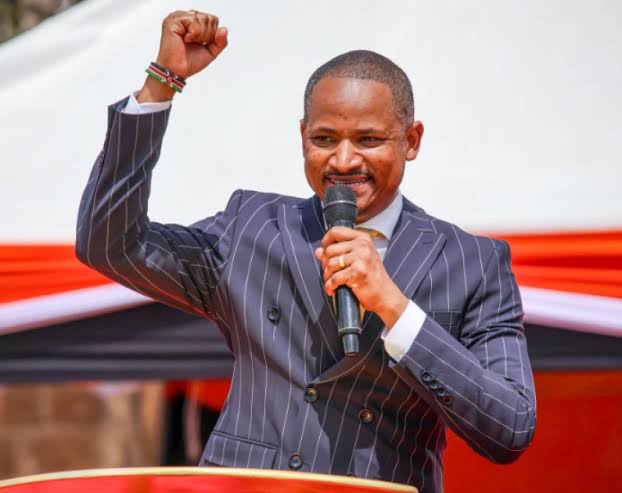
A recent political message invoking the awakening of the Mulembe Nation in support of Edwin Sifuna captures this sentiment in dramatic language. It speaks of a community that believes it has supported other political formations for decades and is now demanding a greater say in determining its own political future.
But beyond the fiery rhetoric lies a more fundamental question: Is this the awakening of a community seeking political dignity or the emergence of another ethnic political mobilization in a country still struggling to overcome tribal divisions?
The answer requires more than slogans, emotional declarations, or social media battles.
It requires a serious examination of Kenya's political history.
THE POLITICS OF LOYALTY AND DISAPPOINTMENT
For decades, Kenya's electoral landscape has been shaped by coalitions built around personalities, ethnic constituencies, regional interests, and calculations of political power.
Communities have supported presidential candidates, negotiated for positions, mobilized voters, and expected their loyalty to translate into influence in government.
Sometimes those expectations have been met. At other times, supporters have felt sidelined after elections, their political importance remembered during campaigns but seemingly forgotten when power is distributed.
Such perceptions can become politically explosive.
When a community repeatedly believes that it has supplied votes without receiving commensurate influence, its patience may eventually wear thin. Leaders who once enjoyed unquestioned support can find themselves confronted by a new generation asking difficult questions.
Who negotiated on our behalf?
What did we gain from those alliances?
Were our interests represented, or were we simply numbers in somebody else's political arithmetic?
These are legitimate questions in a democracy.
However, the answers cannot be reduced to the assumption that every member of a community shares one political opinion or that an entire ethnic group has collectively reached a single conclusion.
The Luhya community, like every other Kenyan community, contains competing political interests, ideological differences, and diverse opinions about leadership.
Its political future cannot be determined by a slogan alone.
EDWIN SIFUNA AND THE POLITICS OF SYMBOLISM
The name of Edwin Sifuna has become a focal point in the political conversation represented by the message.
For some of his supporters, he symbolizes a more assertive political voice and a willingness to challenge established political arrangements. For others, the important question is whether the political energy surrounding him can translate into a coherent program capable of addressing the everyday concerns of ordinary Kenyans.
Those are two different tests.
Political symbolism can mobilize people, but governance requires more than mobilization.
It requires policy positions, organizational discipline, accountability, economic ideas, and the capacity to build relationships across regional and ethnic boundaries.
If a political movement is to endure beyond the excitement of the moment, it must explain what it intends to do about unemployment, the cost of living, agricultural markets, public debt, education, healthcare, corruption, and the accountability of public officials.
The challenge for any emerging political force is to transform popular frustration into a practical agenda.
Otherwise, the giant may awaken only to discover that the political landscape has changed very little.
MUDAVADI, WETANG'ULA, AND THE QUESTION OF POLITICAL SPACE
The original message also invokes Musalia Mudavadi and Moses Wetang'ula, two prominent figures in Kenya's national political landscape.
Their mention reflects a broader debate about political representation, leadership competition, and who speaks for the interests of the wider Luhya community.
But the existence of multiple influential leaders is not, by itself, evidence that any one of them has failed their community.
Political leadership is not the exclusive property of a single individual, family, faction, or generation.
Nor should the emergence of a new political voice automatically be interpreted as a declaration of war against established leaders.
Democracy permits disagreement. It allows established politicians to defend their records and emerging leaders to question them.
The public should therefore evaluate political leaders by their decisions, records, public commitments, and willingness to answer difficult questions.
A leader's political standing should not depend exclusively on the community from which they originate.
It should also depend on what they have done for the people they represent and how they intend to serve the country.
WHEN RELIGION ENTERS THE POLITICAL ARENA
The message's reference to religious leaders raises another important question: What role should faith institutions play in political debate?
Religious leaders occupy a position of considerable moral influence in many Kenyan communities. Their voices can encourage peaceful coexistence, challenge corruption, defend vulnerable citizens, and demand accountability from those exercising public authority.
They also have a responsibility to protect the independence and credibility of their institutions.
When religious leaders speak about justice, equality, corruption, or the dignity of citizens, their contribution can strengthen public debate.
But when religious authority becomes indistinguishable from partisan political mobilization, questions inevitably arise about neutrality, inclusion, and the treatment of believers who hold different political opinions.
The appropriate standard should not be whether religious leaders support or criticize a particular politician.
It should be whether their interventions uphold constitutional values, protect human dignity, and encourage peaceful democratic participation.
Silence in the face of injustice deserves scrutiny. So does the selective application of moral standards.
THE THIN LINE BETWEEN SOLIDARITY AND TRIBALISM
Perhaps the most sensitive part of the original message is its defense of Mulembe's political solidarity against accusations of tribalism.
There is an important distinction that Kenya must learn to recognize.
Communities have legitimate cultural identities, historical experiences, and regional interests. Citizens have the right to organize politically, demand representation, and advocate for the development of their regions.
Such participation does not automatically amount to tribalism.
However, ethnic solidarity becomes dangerous when political belonging is treated as a qualification for public office, when other communities are regarded as enemies, or when citizens are pressured to support leaders simply because they share an ethnic identity.
The Constitution of Kenya establishes national values that include human dignity, equity, social justice, inclusiveness, equality, and non-discrimination.
These principles must apply equally to every political movement and every community.
A community can demand a fair share of leadership without denying another community the same right.
It can celebrate its cultural identity without treating national citizenship as secondary.
It can support a leader from its region without demanding unquestioning loyalty from every person who shares its heritage.
The real test of political maturity is not whether a community can mobilize behind one of its own, but whether it can pursue its interests without undermining the rights and dignity of others.
WHO BENEFITS WHEN COMMUNITIES TURN AGAINST ONE ANOTHER?
Kenya's political history offers a recurring lesson: ethnic mobilization can create bargaining power, but it can also narrow the national conversation.
When political competition becomes a contest between communities, substantive questions risk disappearing beneath the noise.
Citizens may debate who insulted whom at a funeral while paying less attention to the price of maize, the availability of fertilizer, the condition of rural roads, the quality of public hospitals, or the opportunities available to unemployed young people.
They may celebrate the number of leaders who attended a political rally without asking what those leaders have promised to deliver.
They may defend political personalities more fiercely than they defend public resources.
That is the danger.
Political mobilization should expand the space for accountability, not shrink it.
If the emerging debate around Sifuna and Mulembe political identity is to contribute meaningfully to Kenya's democracy, its participants must be prepared to answer a difficult question: What concrete changes should ordinary citizens expect if the political arrangements they criticise are replaced?
The answer must extend beyond positions at the national negotiating table.
It must address the material conditions of ordinary people.
THE AWAKENING MUST BE ABOUT MORE THAN POWER.
A political awakening is meaningful when it changes how citizens understand power and demand accountability.
It is not enough to replace one set of political personalities with another while preserving the same practices of exclusion, patronage, and unfulfilled promises.
It is not enough to condemn political betrayal while excusing misconduct by leaders regarded as allies.
And it is not enough to demand inclusivity for one community while resisting it for another.
Consistency is the foundation of credible political reform.
If the sleeping giant is truly awakening, the awakening should be visible in the quality of public debate, the independence of citizens, the strength of democratic institutions, and the willingness of leaders to submit to scrutiny.
It should also be visible in the ability of communities to cooperate across ethnic boundaries without surrendering their identities or their legitimate interests.
Kenya needs citizens who can challenge political leaders without fear, reject ethnic intimidation without shame, and demand equitable development without being manipulated by those seeking power.
THE FINAL QUESTION: WHO CAN PUT THE GIANT BACK TO SLEEP?
The metaphor of the sleeping giant is powerful, but it should not obscure the fact that Kenya's political future is not the possession of any single community.
No ethnic group has a monopoly on political awakening. No community has an exclusive claim to national leadership. And no political personality, however popular, should be placed beyond public scrutiny.
The ultimate power belongs to citizens acting through constitutional democratic processes.
If the current political moment represents a genuine awakening, its durability will depend on what follows the slogans: the policies proposed, the alliances formed, the accountability demanded, and the treatment of citizens who disagree.
The real question is therefore not simply who can put the giant back to sleep.
It is whether the giant, once awake, will use its strength to build a more inclusive Kenya—or whether it will reproduce the very political divisions that have frustrated generations of citizens.
Because an awakening that merely changes who occupies the seat of power is not necessarily transformation. Transformation begins when citizens change the terms on which power is exercised.
And when that happens, the shockwaves should not be felt by one community alone.
They should be felt in every institution, every political party, and every corner of a republic whose citizens deserve dignity, justice, accountability, and equal opportunity.
No comments yet. Be the first to share your thoughts.