
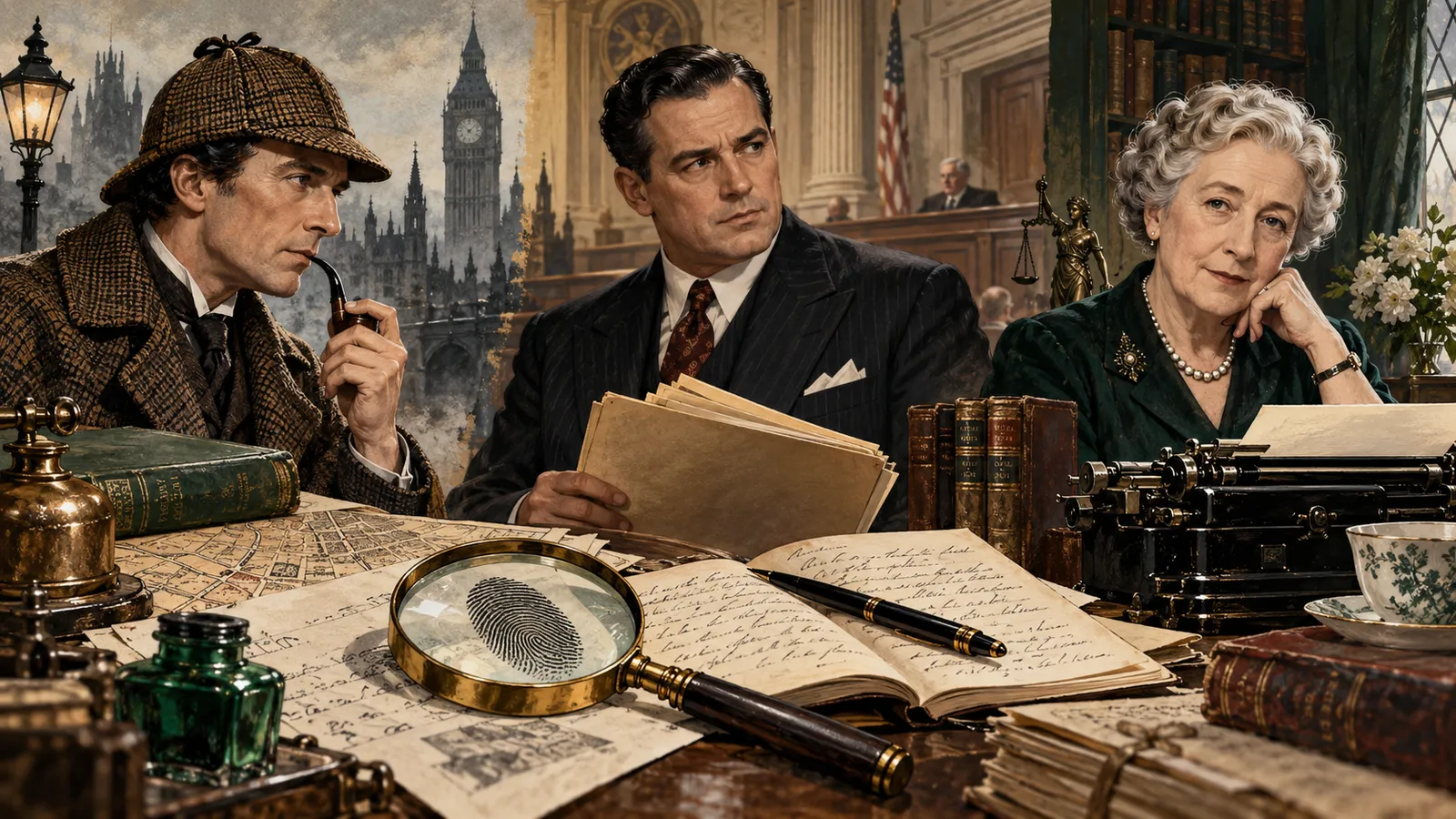
Three names have become almost synonymous with the pursuit of truth through mystery: Sherlock Holmes, Perry Mason and Agatha Christie.
They belong to different worlds. Holmes and Mason are fictional creations; Christie was a real writer whose imagination produced some of the most enduring detectives in literature. Yet behind their different methods lies one powerful idea:

Truth does not announce itself. It has to be pursued.
That is an idea I have encountered throughout my own professional life—as a former police investigator, investigative journalist and lecturer in Criminology and Security Studies at Laikipia University.
I have learned that investigation is rarely about finding the answer first. It is about finding the trail first—and having the discipline to follow it wherever it leads.
Holmes: Follow the clue

Sherlock Holmes, created by Sir Arthur Conan Doyle and first introduced in A Study in Scarlet in 1887, represents the investigator's obsession with observation, deduction and detail.
Holmes looks where others do not look. He notices what others dismiss. A footprint, a stain, a missing object, a peculiar statement or an apparently insignificant movement may become the key to an entire mystery.
His world of 221B Baker Street, with Dr John Watson at his side, has become part of the mythology of detective work.
But beneath the fiction lies an enduring investigative lesson:

Never allow an assumption to become a substitute for evidence.
That principle has followed me into investigative journalism.
When I investigate a story, particularly one involving crime, corruption, death or public controversy, I cannot afford to fall in love with the first explanation I encounter.
I must ask:

What do the documents say?
What do the witnesses say?
What does the physical evidence suggest?
What is missing?

What does not fit?
And perhaps most importantly:
What question has not yet been asked?
The trail matters more than the theory.

A good investigator does not force evidence to fit a predetermined conclusion. He allows the evidence to construct the conclusion.
That is the Holmes within me.
Mason: Put the evidence on trial
If Holmes teaches us to follow the clue, Perry Mason teaches us to test the evidence.
Created by American writer Erle Stanley Gardner, Mason became the archetypal defence lawyer who enters the courtroom apparently surrounded by uncertainty, only to dismantle the prosecution's case through questions, contradictions and unexpected evidence.
Mason's genius is not merely that he knows the law. His strength is his ability to recognise weaknesses in a narrative.
A witness may sound convincing until a simple question exposes a contradiction.
A confident assertion may collapse when confronted with a document.
A seemingly complete story may suddenly develop a missing piece.
A theory may appear strong until somebody asks the question nobody had thought to ask.
This is where journalism and courtroom advocacy meet.
Investigative journalism, at its best, is not simply storytelling. It is testing competing versions of reality.
Every claim should face interrogation.
Who said it?
When was it said?
Why was it said?
Can it be independently verified?
What documents support it?
Who disputes it?
What evidence contradicts it?
And what would happen if the central claim turned out to be wrong?
These questions are not intended to destroy a story. They are intended to strengthen it.
As a journalist, I have learned that the most dangerous sentence in an investigation is sometimes: “It is obvious.”
Nothing should be obvious merely because everyone believes it.
Evidence must survive scrutiny.
That is the Mason within me.
Christie: The mystery of human behaviour
Then there is Agatha Christie, whose contribution to detective fiction operates on another level.
Christie created some of the world's most famous fictional investigators, including Hercule Poirot and Miss Marple. Her mysteries demonstrated that solving crime is not merely about physical clues. It is also about understanding people.
People lie.
People conceal.
People exaggerate.
People forget.
People protect others.
People protect themselves.
And sometimes people tell the truth in a way that makes the truth difficult to recognise.
Christie's great strength was her understanding of human behaviour.
The crime scene may provide the physical evidence, but human beings provide the context.
Why did someone behave in a particular way?
Why did a witness remember one detail but forget another?
Why did someone volunteer information nobody had requested?
Why was one fact concealed while another was repeatedly emphasised?
Why does one person's account contradict another's?
These questions belong not only to fictional detectives. They belong to investigators, journalists, lawyers, criminologists and researchers.
Christie's detectives remind us that motive, opportunity, relationships and behaviour can be as revealing as fingerprints.
But they also teach another important lesson: appearances can deceive.
The person who appears most suspicious may not be responsible.
The person who appears most helpful may know more than they reveal.
The obvious explanation may be precisely the explanation that deserves the greatest scrutiny.
That is the Christie within me.
From the police station to the newsroom
My own journey through investigation has taken me through different professional environments.
As a police officer, I learned the discipline of procedure, observation, evidence and interrogation.
The police investigator works within a structured environment. There is an occurrence book entry, a complaint, a statement, a scene, exhibits, witnesses, suspects and a chain of events that must be reconstructed.
The investigator cannot simply say, “I think this is what happened.”
The question is:
What can be established?
Later, as a journalist, I entered another investigative environment—the newsroom.
Here the tools were different, but the fundamental discipline remained remarkably similar.
The journalist receives information.
The reporter checks it.
The investigative journalist goes further.
He asks for documents.
He identifies sources.
He compares accounts.
He follows money.
He traces relationships.
He examines official records.
He looks for inconsistencies.
He asks questions that people would rather not answer.
And sometimes, most importantly, he waits.
Because investigation requires patience.
The truth does not operate according to a newsroom deadline.
The crime scene always speaks
One of the enduring lessons of criminal investigation is that a scene can contain information even when nobody deliberately leaves a message behind.
The investigator's task is to recognise those traces.
A disturbed object.
A footprint.
A broken lock.
A telephone call.
A financial transaction.
A CCTV recording.
A vehicle movement.
A change in behaviour.
A witness who appears to know something he should not know.
A contradiction in a statement.
A document that appears insignificant.
An omission.
These may be fragments.
But investigation is often the process of assembling fragments until they begin to form a coherent picture.
This is why I have always been uncomfortable with premature conclusions.
The absence of an obvious clue does not necessarily mean the absence of evidence.
Sometimes the evidence is hidden in the contradiction.
Sometimes it is in the timeline.
Sometimes it is in what someone failed to say.
Sometimes it is in what happened immediately before or after the event.
And sometimes the most important clue is the one everybody walked past because it appeared too ordinary.
That is Holmes.
But testing whether that clue actually means what we think it means is Mason.
Understanding the people behind the clue is Christie.
Ne temere: Do not investigate rashly
There is a Latin expression that fits the investigative philosophy I have developed over the years:
Ne temere.
It carries the sense of “not rashly” or “do not act hastily.”
For an investigator, journalist or criminologist, it is more than a Latin phrase.
It is a professional discipline.
Do not conclude before examining the evidence.
Do not accuse before establishing the facts.
Do not mistake suspicion for proof.
Do not confuse a compelling narrative with a demonstrated truth.
Do not allow pressure, emotion, public opinion or institutional expectations to determine the conclusion before the evidence has spoken.
This becomes particularly important in high-profile criminal investigations.
When a lawyer is killed, when a doctor dies under suspicious circumstances, when a politician is accused of wrongdoing, when a police officer is implicated in a crime, or when a suspect is arrested, the public naturally wants answers.
But investigators must resist the temptation to provide answers merely because society demands them quickly.
An arrest is not the same thing as a conviction.
A suspicion is not evidence of guilt.
A compelling theory is not necessarily the truth.
The investigative process must remain open until the evidence closes it.
The journalist as detective
There is an important relationship between investigative journalism and criminal investigation.
Both begin with uncertainty.
Both require the reconstruction of events.
Both depend on sources.
Both demand corroboration.
Both must distinguish fact from allegation.
Both confront people who may have reasons to conceal information.
And both require the investigator to recognise that the first version of events may not be the final version.
But there is also a crucial difference.
A police investigator works within the criminal justice system and under legal procedures.
A journalist's responsibility is to the public record and to the principles of accurate, fair and responsible journalism.
The journalist is not a policeman.
He does not arrest people.
He does not determine guilt.
He does not substitute his own judgment for that of the courts.
His responsibility is to investigate, verify, question and report.
That distinction has remained important throughout my career.
The journalist must be curious without becoming reckless.
Sceptical without becoming cynical.
Persistent without becoming prejudiced.
And courageous without abandoning accuracy.
The lecturer in me
My work in Criminology and Security Studies has added another dimension to the detective within me.
Teaching investigation requires more than explaining how criminals are caught.
It requires understanding why investigations succeed or fail. Students must learn that evidence does not exist in isolation. It exists within institutions, communities, cultures and human relationships.
They must understand criminal behaviour, victimology, policing, courts, media representations, social structures and the psychology of witnesses and suspects. They must also understand the danger of confirmation bias—the tendency to search for or interpret information in ways that reinforce what one already believes.
This is perhaps one of the greatest enemies of investigation. Once an investigator becomes convinced that a particular person is responsible, every subsequent fact can be unconsciously interpreted to support that belief.
The investigator stops asking:
“What happened?”
and begins asking:
“How can I prove what I already believe happened?”
That is a dangerous transformation.
The detective must remain intellectually uncomfortable.
He must be prepared to discover that his theory is wrong.
Three detectives, one philosophy
Holmes, Mason and Christie represent three different dimensions of investigative thinking.
Holmes represents observation and deduction.
Look carefully.
Notice the unusual.
Follow the clue.
Mason represents interrogation and evidentiary testing.
Question the witness.
Challenge the narrative.
Expose contradictions.
Christie represents human behaviour and the complexity of motive.
Study relationships.
Understand deception.
Look beyond appearances.
Together they form a useful investigative triangle:
Observe. Question. Understand.
That philosophy extends far beyond crime.
It applies to journalism.
It applies to academic research.
It applies to auditing.
It applies to governance.
It applies to intelligence analysis.
It applies to public policy.
It even applies to ordinary life.
Whenever we encounter a claim, we should ask what evidence supports it.
Whenever we encounter conflicting accounts, we should ask why they differ.
Whenever something appears too simple, we should ask whether we have missed something.
The detective never stops asking questions
Perhaps this is what has fascinated me most about investigation.
It is not the glamour.
It is not the dramatic arrest.
It is not the courtroom revelation.
It is the question.
One question leads to another.
One document leads to another document.
One witness leads to another witness.
One inconsistency opens another line of inquiry.
The investigation becomes a journey from uncertainty towards a defensible understanding of what happened.
Sometimes the answer is immediate.
Sometimes it takes years.
Sometimes the evidence remains inconclusive.
A responsible investigator must have the courage to say:
“We do not know yet.”
That may sound like weakness.
It is actually intellectual honesty.
The investigator who admits uncertainty is often closer to the truth than the person who confidently declares an answer unsupported by sufficient evidence.
The detective in me
I have spent different chapters of my life wearing different professional identities: police officer, investigator, journalist, editor, researcher and lecturer.
But underneath those identities there has been a common thread.
The search for truth.
The police officer in me asks: What happened?
The journalist in me asks: How do we know?
The criminologist in me asks: Why did it happen?
The teacher in me asks: What can we learn from it?
And the detective in me keeps asking:
What are we missing?
Perhaps that is why Holmes, Mason and Christie continue to fascinate me.
They remind us that investigation is not simply about intelligence.
It is about discipline.
Not merely about suspicion, but verification.
Not merely about finding clues, but interpreting them correctly.
Not merely about constructing theories, but having the courage to abandon them when the evidence demands it.
Holmes teaches me to look.
Mason teaches me to question.
Christie teaches me to understand people.
And ne temere reminds me not to rush.
Because in investigation, the greatest danger is not always failing to find the truth.
Sometimes it is believing we have found it before we have actually looked everywhere.
And that is where the detective in me begins.
Available next action.
No comments yet. Be the first to share your thoughts.