
By Xavier Lugaga
The crowd had gathered in the heart of the Vatican to see a man millions regarded as a spiritual father.
Some had travelled hundreds of kilometres. Others had crossed international borders, carrying rosaries, religious medals and hopes of receiving the blessing of the newly elected leader of the Roman Catholic Church.
On that warm Wednesday afternoon, May 13, 1981, Pope John Paul II was doing what he had become known for: drawing close to ordinary people, greeting pilgrims and blessing children as he moved through St Peter’s Square in an open white vehicle.
There was no apparent indication that the public audience would become one of the most shocking moments in modern Catholic history.
Then came the gunshots.
The Pope, who had travelled through the square among the faithful, was struck by bullets fired at close range. The cheerful atmosphere dissolved into confusion, fear and desperate prayers.
People struggled to understand what had happened. Some screamed. Others froze in disbelief. As security personnel rushed to protect the wounded pontiff, the square that had moments earlier echoed with greetings and applause became a scene of panic.
The man who had survived the Nazi occupation of Poland, witnessed the brutality of the Second World War and endured the repression of communist rule was now fighting for his life.
His attacker was Mehmet Ali Ağca, a Turkish gunman whose actions would permanently connect his name to an assassination attempt that continues to fascinate historians, religious believers and investigators.
Yet, as the world waited anxiously for news from the hospital, another detail emerged that would give the tragedy a profound spiritual significance for millions of Catholics.
The date was May 13—the feast of Our Lady of Fatima.
For John Paul II, the coincidence would become inseparable from his conviction that the Virgin Mary had intervened to save his life.

The Vatican's historical account confirms that the Pope was seriously wounded during the attack and underwent an operation lasting approximately five and a half hours.
A DAY THAT CHANGED THE VATICAN FOREVER
The assassination attempt occurred during the weekly general audience, when the Pope was greeting pilgrims in St Peter’s Square.
John Paul II, born Karol Józef Wojtyła in Poland on May 18, 1920, had become pope in October 1978. His election had made him the first non-Italian pontiff in more than four centuries.

His Polish background, experience of totalitarian rule and commitment to human dignity had given his papacy a distinctive character.
To millions of Catholics, he represented spiritual renewal. To many people living under communist governments in Eastern Europe, he symbolised the possibility of freedom and resistance through faith.
His popularity also made his public appearances major international events, attracting crowds of pilgrims who wanted to see him in person.
On May 13, 1981, he was moving through St Peter’s Square in the white Fiat Campagnola that served as his popemobile when Ağca opened fire.
The Vatican records that the Pope was hit by two gunshots. He was rushed to Rome’s Gemelli Hospital, where doctors undertook emergency surgery to save his life.
The injuries were serious. His survival was far from something that could simply be taken for granted.
As medical teams worked to stabilise him, the world watched and waited.
At the Vatican, the shock was immediate. For the faithful, the thought that the leader of the Catholic Church could be gunned down while blessing pilgrims was difficult to comprehend.
But as the initial terror gave way to anxious waiting, prayers began to spread across the world.
Churches and religious communities united in supplication for the Pope's recovery. For many believers, prayer was their immediate response to an act of violence that had struck not only an individual but also a figure they regarded as a shepherd to the universal Church.
The crisis had begun with gunfire. Its lasting legacy, however, would be shaped by something very different: the Pope's response to suffering, his devotion to Mary and his decision to forgive the man who tried to kill him.
THE EXTRAORDINARY SIGNIFICANCE OF MAY 13
To understand why the date of the attack became so important to John Paul II, one must travel back to Portugal in 1917.
According to Catholic tradition, the Virgin Mary appeared to three young shepherd children—Lucia dos Santos, Francisco Marto and Jacinta Marto—in the area of Cova da Iria, near Fatima.
The reported apparitions took place between May and October 1917, during a period when Europe was engulfed in the First World War and Portugal was experiencing profound social and political change.
The children said they had encountered a woman dressed in white who delivered messages centred on prayer, repentance, conversion and peace.
The events drew growing attention, eventually making Fatima one of the world's most important Catholic pilgrimage destinations.
May 13 became especially significant because it marked the date of the first reported apparition.
For generations of Catholics, the anniversary has represented a time for prayer, reflection and renewed devotion to the Virgin Mary.
When John Paul II was shot on that same date in 1981, the connection immediately captured the attention of the faithful.
For some, it was an extraordinary coincidence. For others, it was a moment whose spiritual meaning seemed impossible to ignore.
For the Pope himself, the connection became deeply personal.
His devotion to Mary had long been central to his spiritual life. His episcopal motto, Totus Tuus, meaning “Totally Yours,” expressed his particular consecration to the Virgin Mary.
Following the assassination attempt, that devotion acquired an even more intimate dimension.
He came to believe that Mary's maternal intercession had helped preserve his life.
The Vatican's own reflection on the Fatima message later described the Pope's conviction in striking terms: a mother's hand had guided the bullet's path, allowing him to remain alive when death appeared imminent.
For believers, the story became a powerful illustration of divine providence.
For historians, the date remains a remarkable intersection between a major political and religious event and one of the Catholic world's most important Marian anniversaries.
The distinction matters: the date and the shooting are established historical facts, while the claim of Mary's miraculous intervention is John Paul II's religious conviction, embraced by many Catholics as an expression of faith.
THE BULLET THAT BECAME A RELIGIOUS SYMBOL
Perhaps no object captures the story more powerfully than the bullet associated with the assassination attempt.
A projectile that had once represented violence and the possibility of death would eventually become part of a sacred object revered by pilgrims at Fatima.
After recovering from his injuries, John Paul II returned to the spiritual significance of the day on which he had nearly died.
He subsequently travelled to Fatima, Portugal, where he expressed gratitude for what he believed was the Virgin Mary's protection.
He also arranged for a bullet from the attack to be given to the shrine.
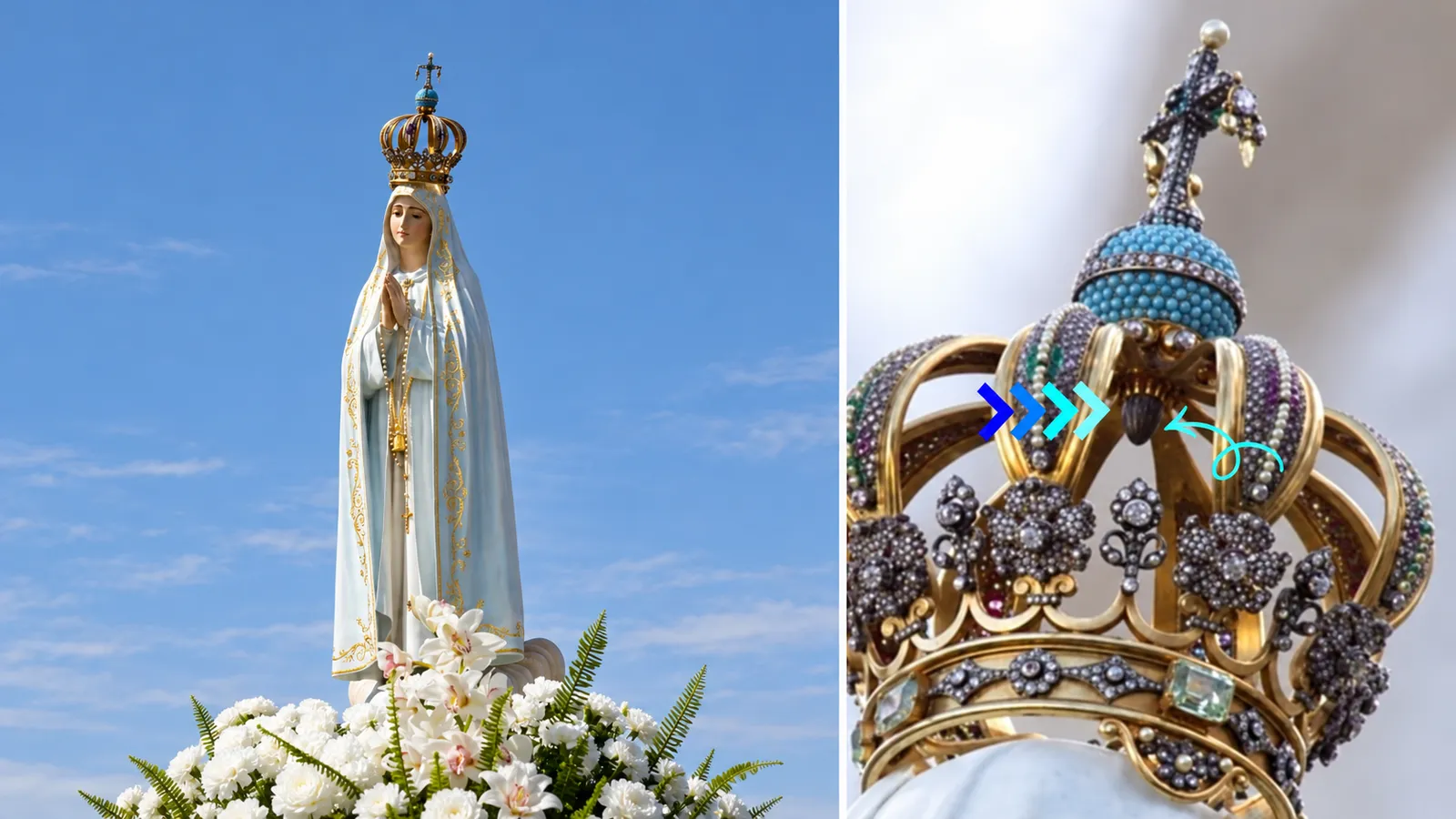
According to the Shrine of Fatima, the bullet was offered on March 26, 1984. It was later incorporated into the crown of the statue of Our Lady of Fatima in 1989.
The crown already held profound significance for Portuguese Catholics. It had been offered by Portuguese women in 1942 and was made from donated gold and precious stones.
The addition of the bullet gave it another layer of meaning.
The projectile, once a weapon of attempted assassination, became a reminder of survival, gratitude and the Pope's unwavering faith.
It was not simply an unusual historical artefact. For believers, it represented a life preserved and a prayer answered.
The symbolism is striking.
A bullet designed to destroy life became a silent witness to the Pope's conviction that his survival had been entrusted to the maternal protection of Mary.
Within the crown, the object that had once carried the threat of death came to represent hope.
For pilgrims visiting Fatima, the story continues to connect the events of May 13, 1981, with the shrine's enduring message of prayer, conversion and peace.
“A MOTHER'S HAND” AND THE MYSTERY OF SURVIVAL
John Paul II never treated his survival as an ordinary medical outcome alone.
He acknowledged the role of those who treated him, but his interpretation of the experience also rested on his religious conviction that his life had been preserved through Mary's intercession.
One of the most frequently cited expressions of this belief is his reflection that a mother's hand guided the bullet's path.
The sentiment is sometimes paraphrased in popular Catholic accounts as: “One hand fired, and another guided the bullet.”
The precise wording should be distinguished from the Pope's documented reflection, but the meaning captures the conviction that shaped his understanding of the assassination attempt.
He believed that the Virgin Mary had been present in his moment of greatest vulnerability.
The Vatican later recalled his reflection that the maternal hand of the Mother of God had guided the bullet's course, allowing the Pope to stop at the threshold of death.
For John Paul II, this was not simply a story of having survived an attack.
It was a reminder of human fragility, the mystery of suffering and the responsibility that accompanies the gift of life.
He had come close to death in a public square surrounded by people who had gathered to celebrate their faith.
He emerged from the experience with a deeper determination to continue his ministry.
His survival became, in his own understanding, an invitation to serve rather than a reason to retreat.
THE MOST UNEXPECTED RESPONSE: FORGIVENESS
If the bullet and the date gave the story its extraordinary religious symbolism, the Pope's response to his attacker revealed another dimension of his character.
On December 27, 1983, more than two years after the shooting, John Paul II visited Ağca in prison.
The encounter attracted international attention because it brought together the two men at the centre of the assassination attempt: the Pope who had been shot and the prisoner who had fired the weapon.
The meeting was private, and their conversation was not intended as a public spectacle.
But its significance was unmistakable.
The Pope had gone to see the man who had tried to kill him.
He spoke with Ağca and forgave him.
The Vatican's historical account confirms that John Paul II met his attacker in prison and extended forgiveness after the assassination attempt.
The gesture reflected a central teaching of Christianity: that forgiveness should not be confined to easy circumstances or reserved for those who have never caused serious harm.
Forgiveness did not mean that the shooting had never happened, nor did it erase the criminal responsibility associated with the attack.
Rather, it demonstrated that the Pope refused to allow hatred to dictate his response.
His action was particularly striking because he had been the direct victim of an attempt on his life.
In a world where political violence frequently breeds retaliation, John Paul II offered a different example.
He chose mercy over vengeance.
For many Catholics, that decision became one of the most compelling aspects of the entire episode. It showed how his Marian devotion was connected to a wider commitment to Christian forgiveness.
The Pope's faith was not expressed only through prayers, shrines and religious symbols. It was also reflected in a personal encounter with the man who had caused him immense suffering.
WHO WAS MEHMET ALI AĞCA?
The identity and motives of the gunman have remained subjects of considerable historical interest.
Ağca was a Turkish national who had been involved in militant political circles and had a criminal history before the assassination attempt.
His attack on John Paul II occurred against the background of intense political tensions in Europe, including Cold War rivalries, extremist violence and the struggle between communist governments and movements seeking political freedom.
Because John Paul II was a prominent religious leader and a symbol of resistance to communist domination in Poland, the shooting immediately generated questions about whether the gunman had acted alone or had been connected to a wider conspiracy.
Investigations and subsequent inquiries explored possible links to broader political interests. The attack consequently became part of a larger debate about the relationship between terrorism, intelligence operations and Cold War politics.
However, the full circumstances surrounding the plot have remained contested, and claims about the involvement of particular governments or intelligence agencies require careful qualification.
The established fact is that Ağca shot and seriously wounded the Pope on May 13, 1981.
The broader questions about the planning and possible connections surrounding the attack should be examined through documentary evidence rather than speculation.
For the Catholic Church, however, the enduring spiritual meaning of the episode has never depended entirely on resolving every historical question about the conspiracy.
Its significance lies also in how John Paul II interpreted his survival and what he did afterwards.
He chose gratitude over bitterness and forgiveness over revenge.
FATIMA: FROM A 1917 MESSAGE TO A MODERN PILGRIMAGE OF HOPE
The story of the assassination attempt cannot be separated from the continuing significance of Fatima.
Located in central Portugal, the Shrine of Our Lady of Fatima attracts pilgrims from across the world.
Some visit to give thanks for what they believe are answered prayers. Others come seeking healing, peace, spiritual renewal or consolation during difficult periods in their lives.
The reported apparitions of 1917 placed prayer and repentance at the centre of the shrine's religious identity.
The association with John Paul II gave Fatima an additional connection to contemporary history.
His visits to the shrine, particularly after the assassination attempt, reinforced his conviction that Mary had protected him.
The bullet incorporated into the statue's crown remains a physical reminder of that connection.
It also demonstrates how objects can acquire profound meaning within religious traditions.
To someone viewing it simply as a projectile, the bullet is evidence of a violent historical event.
To a Catholic pilgrim, it may represent the difference between life and death, a mother's protection and the power of prayer.
The two perspectives need not be confused. One concerns the physical object and the documented history of the attack; the other concerns the spiritual meaning that believers attach to those events.
Together, they explain why the story continues to attract attention decades later.
A LIFE THAT CONTINUED WITH RENEWED PURPOSE
John Paul II's recovery was not instantaneous. The injuries and subsequent medical complications marked a difficult period in his life.
Yet he returned to his responsibilities and continued one of the most consequential papacies of the modern era.
He travelled extensively, met political and religious leaders, addressed questions of human dignity and freedom, and continued to engage with people across different cultures and nations.
His papacy lasted until his death on April 2, 2005.
In 2014, he was canonised by Pope Francis, becoming Saint John Paul II.
His canonisation formally recognised his sanctity according to the Catholic Church's process, while his life and teachings continued to inspire devotion among Catholics and interest among people beyond the Church.
The 1981 assassination attempt remains one of the defining episodes of his pontificate because it revealed several dimensions of his character at once: physical vulnerability, deep religious conviction, courage in the face of danger and a willingness to forgive.
It also reinforced his commitment to the Marian devotion expressed in his motto, Totus Tuus.
The man who survived the gunshots believed that his life had been preserved for a reason.
He continued his mission with the conviction that survival carried responsibilities beyond himself.
THE ENDURING MESSAGE: FAITH, MERCY AND THE VALUE OF LIFE
More than four decades after the gunshots rang out in St Peter's Square, the story of John Paul II and Our Lady of Fatima continues to resonate because it brings together violence, survival, faith and forgiveness.
It begins with a terrifying act: a gunman firing at a pope who was greeting pilgrims.
It moves through the uncertainty of emergency surgery and the prayers of millions who feared that the leader of the Catholic Church might die.
It then takes an extraordinary turn through the Pope's interpretation of the date, his devotion to Mary and his decision to preserve a bullet as a gift to the shrine at Fatima.
Finally, it reaches its most personal expression in his meeting with Ağca, when the victim chose to forgive the man who had tried to kill him.
For Catholics, the episode remains a powerful testimony to the belief that the Virgin Mary intercedes for those who seek her help.
For others, it offers a compelling historical reflection on the way faith can shape a person's response to trauma, suffering and violence.
The story does not require everyone to interpret the events in precisely the same way to recognise the significance of the Pope's response.
His survival was a medical and historical reality. His conviction that Mary had protected him was an expression of faith. His forgiveness of Ağca was a documented act that gave that faith a human face.
Perhaps that is why the bullet in the crown of Our Lady of Fatima continues to hold such powerful symbolism.
It recalls the moment when violence nearly silenced a pope, but also the response that followed: prayer, gratitude, renewed purpose and forgiveness.
For believers, the story remains a reminder that even in moments of profound danger, hope need not disappear.
And for anyone reflecting on the cost of hatred, John Paul II's encounter with his attacker offers a difficult but enduring lesson: forgiveness does not erase the past, but it can prevent the past from dictating the future.
Our Lady of Fatima, pray for us.
Saint John Paul II, pray for us.
No comments yet. Be the first to share your thoughts.