

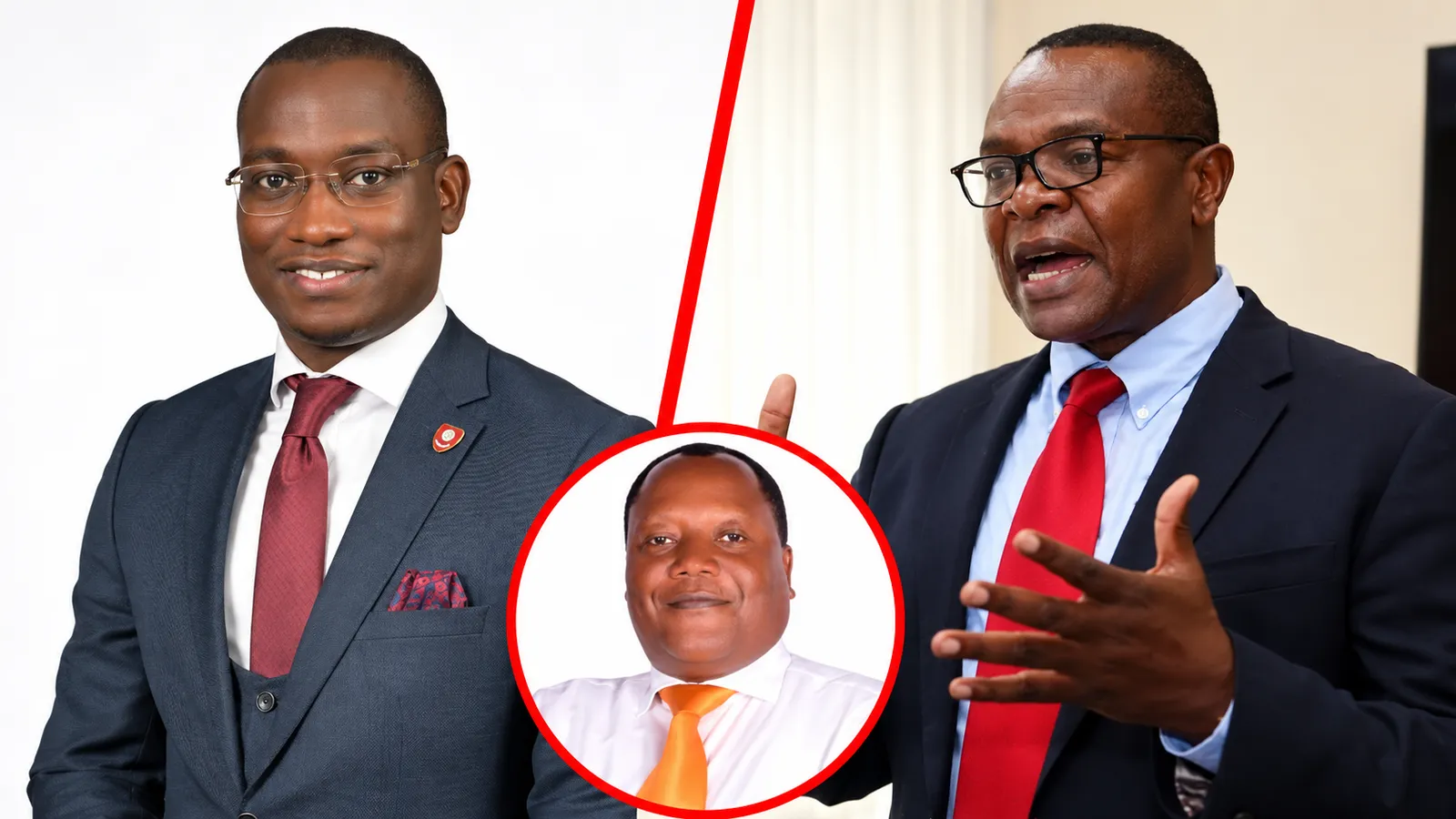
Budalangi MP Raphael Wanjala has launched a blistering attack on Busia Governor Dr. Paul Otuoma, accusing him of failing to deliver development, neglecting healthcare, employing relatives, operating from Nairobi and his private residence, and spending four years in office without completing a single new project.
Wanjala's broadside raises legitimate questions about the performance of Busia's county government. Residents have a constitutional right to demand functioning hospitals, completed infrastructure, transparent recruitment, responsible spending, and a governor who remains accessible to the people.
But there is another side to this political confrontation.
When a legislator declares that an entire county government has achieved nothing in four years, the burden is on him to substantiate that sweeping conclusion with verifiable evidence.
Which projects were budgeted for, funded, and abandoned? Which hospitals have collapsed, and what are their actual operational conditions? Which appointments allegedly favored the governor's relatives? How much money has Parliament allocated to Busia, and how much has actually reached the county government through the constitutional financing framework?
These are not minor questions. They go to the heart of public accountability.
Wanjala's accusations should therefore be examined individually rather than accepted as established facts simply because they were delivered forcefully from a political platform.
FOUR YEARS OF NOTHING? A CLAIM THAT DEMANDS AN AUDIT
Perhaps the most damaging of Wanjala's allegations is that Otuoma has not launched or completed a single new project during his administration.
If accurate, such an indictment would represent a serious failure of county leadership. But if it is exaggerated, incomplete, or contradicted by verifiable development records, it risks misleading the very residents whose interests the MP claims to defend.
The appropriate response is not to dismiss the accusation merely because it comes from a political rival. It is to demand evidence.

Busia County's development record should be assessed against approved annual development plans, budget implementation reports, procurement documents, project inspection reports, and the actual condition of infrastructure on the ground.
A comprehensive audit should identify projects inherited from the previous administration, those initiated under Otuoma, those completed, those still under construction, and those that have stalled.
That distinction matters.
A governor cannot automatically claim credit for every project completed during his tenure. Equally, he should not be declared a failure merely because some projects remain unfinished, especially where their funding, implementation timelines, and original contractual obligations have yet to be examined.

The decisive question is whether the county government has delivered measurable improvements in residents' lives.
How many health facilities have been equipped? Which roads have been improved? What has happened to water projects, agricultural programs, markets, and other essential services? What amounts were budgeted, released, spent, and accounted for?
Wanjala's challenge would carry considerably greater weight if accompanied by a project-by-project inventory identifying the relevant locations, budgets, implementation status, and responsible officers.
Political rhetoric can expose a problem, but documentary evidence is what establishes its scale.
Otuoma, for his part, should publish an accessible performance scorecard showing what his administration promised, what it funded, what it completed, and what remains outstanding.
Busia residents deserve that accounting, irrespective of their political affiliations.
DOES OTUOMA GOVERN FROM NAIROBI AND HIS PRIVATE RESIDENCE?
Wanjala also accuses the governor of operating from Nairobi and his private residence rather than maintaining an effective presence at the county headquarters.
If the allegation is that Otuoma is frequently absent from his official office, the question should be settled through verifiable records rather than political impressions.
A governor's responsibilities extend beyond sitting in an office. They include supervising departments, chairing executive meetings, engaging the county assembly, monitoring development projects, coordinating national government agencies, and responding to residents' concerns.
However, those responsibilities do not excuse persistent inaccessibility or the failure to supervise county operations.
The public deserves to know whether the governor maintains a regular working presence at the county headquarters, whether official meetings take place as scheduled, and whether administrative decisions are being made promptly.
The relevant evidence includes official schedules, records of executive meetings, project inspection reports, and documented engagements with residents and county officials.
If Otuoma routinely conducts official business away from the county headquarters, he should explain how that arrangement serves Busia's interests.
If the accusation is inaccurate, the governor's administration should rebut it with facts.
The issue is not the physical location of a governor at every hour of the day. It is whether the county government is functioning effectively and whether its chief executive is providing visible, accountable leadership.
THE HOSPITALS: ARE BUSIA RESIDENTS BEING FORCED TO SEEK TREATMENT ELSEWHERE?
Wanjala's most emotionally charged accusation concerns healthcare.
He claims that Busia's hospitals have collapsed, have become dens of corruption, and are so inadequate that sick residents travel to Siaya and Kisumu counties in search of treatment.
For families struggling with illness, this is a serious allegation that deserves urgent investigation.
A patient should not have to travel long distances for treatment that a properly equipped and adequately staffed local facility ought to provide. Nor should families be forced to spend money on transport, accommodation, and additional medical expenses because essential services are unavailable.
But the claim that Busia's hospitals have collapsed requires careful examination.
Which facilities lack essential medicines? Where are the critical staffing shortages? Which hospitals lack functioning equipment? Are laboratories operational? Are patients being referred elsewhere because of unavailable specialists, inadequate diagnostic services, equipment failures, or the complexity of their medical conditions?
These distinctions are important because referral to a higher-level facility does not, by itself, prove that a county hospital has collapsed.
At the same time, persistent referrals for services that should reasonably be available locally could expose serious gaps in planning, staffing, financing, and service delivery.
The allegation of corruption must also be investigated on its own merits.
Are there documented procurement irregularities, unexplained stock-outs, disputed tenders, audit queries, or credible complaints involving hospital management? Have any investigations established wrongdoing, or are these allegations awaiting verification?
Calling hospitals dens of corruption is politically explosive. Establishing corruption requires evidence.
The county government should respond by publishing relevant healthcare expenditure, staffing levels, medicine-supply information, audit findings, and facility-level performance data.
The County Assembly's health committee, the relevant oversight institutions, and the Auditor-General's reports should help establish the facts.
Wanjala should identify the facilities and specific failures he is referring to. Otuoma's administration should provide documented answers rather than resorting to political counterattacks.
Healthcare is too important to become a contest of accusations while patients and their families bear the consequences.
THE ALLEGED EMPLOYMENT OF RELATIVES: WHO WAS RECRUITED, AND THROUGH WHICH PROCESS?
Wanjala further accuses Otuoma of employing his kinsmen.
This is a serious charge because county employment is a public resource that must be administered fairly, transparently, and in accordance with the law.
But family or community connections alone do not establish that an appointment was unlawful. The critical questions concern qualifications, recruitment procedures, conflicts of interest, merit, and compliance with the applicable legal requirements.
Who were the individuals allegedly recruited? What positions do they hold? When were they appointed? Were the vacancies advertised? Was a competitive recruitment process conducted? Did the County Public Service Board follow the required procedures?
If the MP possesses evidence that appointments were manipulated to favor relatives or associates, he should place that evidence before the appropriate oversight institutions.
The county government should likewise disclose recruitment information in accordance with applicable law and explain how it safeguards merit and fairness.
Busia residents should not have to rely on political insinuations to understand how public jobs are distributed.
Nor should allegations of nepotism be dismissed merely because the individuals concerned come from the governor's home area.
The standard must be the same for everyone: evidence, due process, and accountability.
PRAISING RUTO: DOES POLITICAL COOPERATION MAKE A GOVERNOR A THIEF?
Wanjala's attack also takes aim at Otuoma's relationship with President William Ruto, arguing that governors who follow and praise the president are thieves.
This is where political criticism risks crossing into sweeping and unjustified generalizations.
A governor's relationship with the national government is a legitimate subject of public debate. Residents are entitled to question whether political cooperation produces tangible benefits for their county or merely offers politicians convenient photographs, public praise, and opportunities for political positioning.
But supporting, cooperating with or praising a president does not, by itself, establish that a governor is corrupt.
Corruption must be demonstrated through evidence of wrongdoing, not inferred from political alignment.
Kenya's devolved system requires county and national governments to interact over financing, infrastructure, healthcare, agriculture, security and other matters of shared responsibility.
Constructive cooperation can benefit residents. Equally, cooperation must never become an excuse for abandoning oversight, concealing wrongdoing or surrendering the county's constitutional interests.
The proper question is therefore not whether Otuoma praises Ruto.
It is whether the relationship has produced measurable benefits for Busia.
Have national government programmes generated employment, improved infrastructure or expanded services in the county? Have the county and national governments coordinated effectively on agriculture, investment and development? Are public resources being used transparently?
If the answers are disappointing, Otuoma should be challenged on his record.
But labelling every governor who supports the President a thief is not a substitute for demonstrating corruption.
A political relationship can be criticised without turning an unproven criminal accusation into a universal verdict.
PARLIAMENTARY ALLOCATIONS: WHERE DOES THE MONEY GO?
Wanjala argues that Parliament has allocated substantial amounts of money to Busia County, raising a fundamental question about the relationship between public funding and visible development.
If Busia has received substantial resources but residents continue to experience poor services, the public is entitled to demand an explanation.
However, the financial trail must be understood correctly.
County governments receive equitable-share allocations under the constitutional framework, alongside conditional allocations and other lawful sources of revenue. Parliament's role includes legislating on public finance and determining national allocations through the relevant constitutional processes.
Money allocated to a county is not necessarily the same as money released, received, spent or converted into completed projects.
A proper investigation must distinguish between approved budgets, exchequer releases, actual county receipts, own-source revenue, expenditure and pending bills.
It must also examine absorption rates, procurement delays, contractual disputes, expenditure priorities and the effectiveness of internal controls.
Where did the money go?
That question should be answered through audited accounts, Controller of Budget implementation reports, procurement records and physical inspections of projects.
If funds were released but development failed to materialise, the county executive must explain why.
If allocations were delayed, reduced or tied to specific conditions, those circumstances must also be established.
If money was lost through fraud, misappropriation or irregular expenditure, the responsible individuals should face the appropriate investigations and legal processes.
Wanjala should use his parliamentary position to pursue these questions through the relevant oversight channels and make the findings available to the public.
The governor, meanwhile, should not treat criticism of county expenditure as political hostility. Public money belongs to the people, and explaining its use is a constitutional responsibility.
WHAT ABOUT THE GOVERNOR'S OWN DEFENCE?
Although Wanjala's allegations deserve scrutiny, Otuoma should not expect to escape accountability simply because some of the MP's language may be exaggerated or politically charged.
The governor's administration must answer the substance of the criticism.
A convincing defence cannot consist solely of listing meetings attended, promises made or projects launched. Residents need evidence of delivery.
A project launch is not the same as completion. A budget allocation is not the same as expenditure. Expenditure is not necessarily proof of value for money.
The county government should publish a consolidated performance report covering the period under review, with project locations, approved costs, expenditure to date, contractors where applicable, implementation status and completion dates.
The same report should address healthcare staffing, essential medicines, equipment availability, referrals, pending bills and recruitment procedures.
Where projects have stalled, the administration should explain the reasons and provide realistic completion timelines.
Where allegations are demonstrably false, it should rebut them with records.
Where shortcomings exist, it should acknowledge them and outline corrective measures.
That is how public trust is earned.
WANJALA SAYS HE CAMPAIGNED FOR OTUOMA. DOES THAT MAKE HIS CRITICISM MORE CREDIBLE?
The MP reportedly says he campaigned for Otuoma but has become disappointed by the governor's performance.
His account introduces another dimension to the dispute: the relationship between political loyalty and public accountability.
If Wanjala supported Otuoma's election and now believes the governor has failed, he is entitled to explain what changed and which campaign commitments he believes have been abandoned.
But having campaigned for a governor does not automatically make his subsequent accusations accurate. Neither does their political history invalidate his criticism.
The test remains evidence.
What promises did the governor make? Which have been fulfilled? Which remain outstanding? What evidence supports the claim that the county has achieved nothing?
The public also deserves to know whether the disagreement concerns policy, development priorities, political realignment or a combination of these factors.
It would be wrong to assume that political rivalry alone explains Wanjala's criticism. It would be equally wrong to assume that every allegation he makes is correct simply because he once supported Otuoma.
The county's development record must be assessed independently of personal relationships and political alliances.
BUSIA DESERVES MORE THAN A WAR OF WORDS
At the centre of this dispute are ordinary residents who want reliable healthcare, better roads, functioning markets, opportunities for young people, support for farmers and a county government that accounts for every shilling.
They are not served by an argument in which one politician declares the county government a total failure while the administration responds with political counterattacks.
They need verifiable information.
If Wanjala's allegations are supported by records, they should trigger appropriate investigations and corrective action. If parts of his account are inaccurate, those claims should be exposed through documentary evidence. If Otuoma's administration has failed in particular sectors, those failures should be acknowledged and addressed.
The same standard should apply to every political leader, whether allied to the national government or opposed to it.
Busia's economic future cannot be built on political loyalty alone. Nor can it be advanced through accusations that are never tested against evidence.
The governor must account for his administration's performance. The MP must substantiate his allegations. Oversight institutions must investigate credible claims, and residents must be given access to reliable information.
THE VERDICT MUST COME FROM THE RECORD, NOT THE RALLY
Wanjala has raised questions that deserve answers, particularly concerning healthcare, employment, project implementation and the use of public funds.
But the assertion that Otuoma has delivered absolutely nothing in four years is too sweeping to accept without a detailed examination of the county's development record.
Likewise, allegations that the governor employs relatives, presides over corrupt hospitals or is a thief because of his relationship with the President must not be treated as proven facts without supporting evidence.
The way forward is a transparent, independently verifiable assessment of Busia County's performance.
Let the county government publish its records. Let the MP identify the projects, facilities, appointments and financial transactions he is challenging. Let auditors, investigators and other competent institutions establish the facts.
If Otuoma has failed, the evidence should expose those failures. If Wanjala has exaggerated, the evidence should expose the exaggeration. And if public resources have been misused, those responsible must answer for their actions.
Busia does not need politicians to manufacture victories or defeats through rhetoric. It needs leaders willing to submit their claims, their records and their performance to public scrutiny.
In the final analysis, the governor does not own Busia County, and neither does the MP. Both hold public responsibilities on behalf of its people.
Their political contest should therefore produce something more valuable than headlines: the truth about how Busia is governed, how its money is spent and whether its residents are getting the services they deserve.
For the people of Busia, the ultimate question is not who has won the political argument. It is who can demonstrate, with evidence, that public office is making their lives better.
No comments yet. Be the first to share your thoughts.