
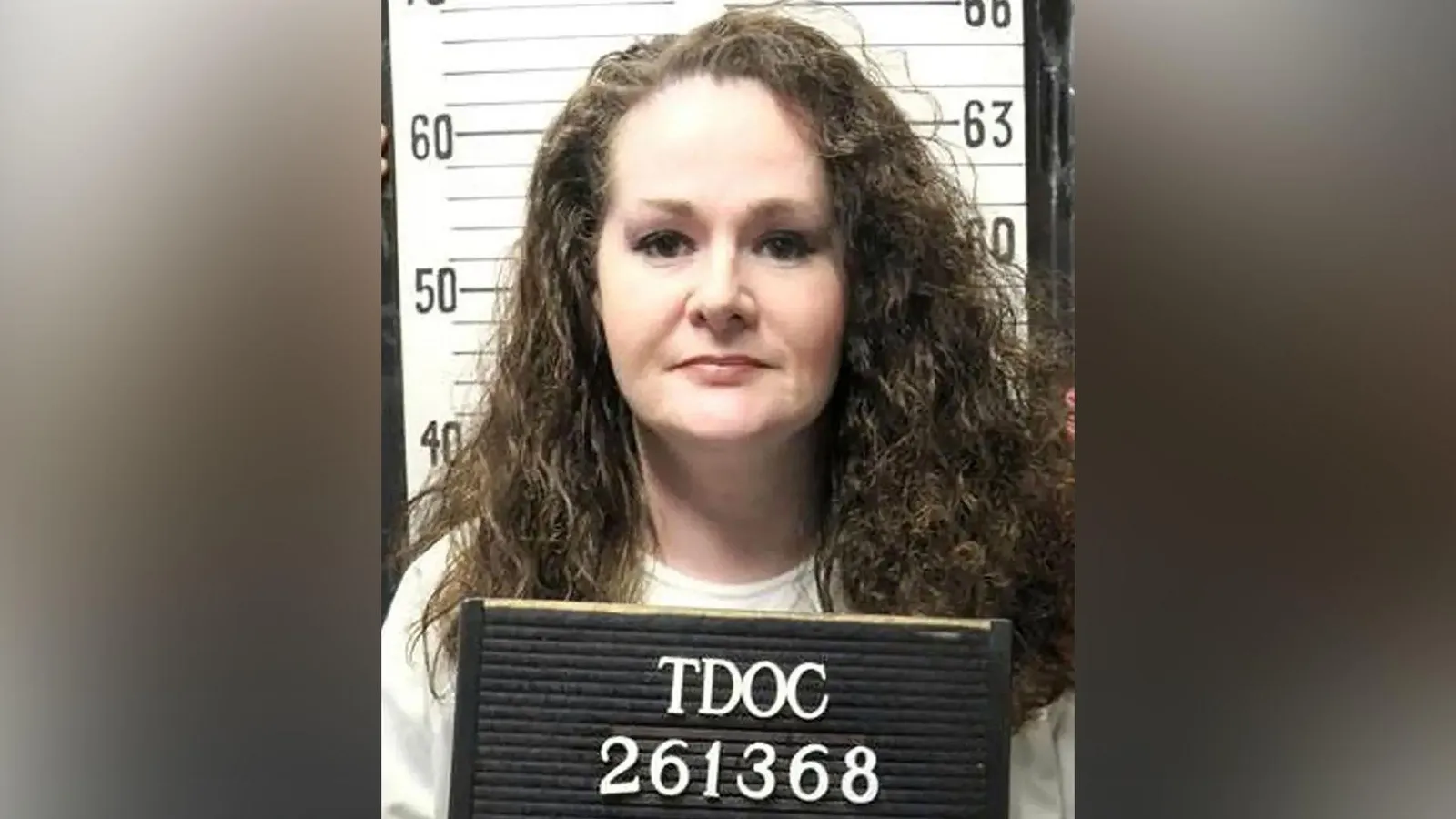
For nearly three decades, Christa Pike had lived beneath the shadow of a date she could not escape.
Death had followed her through prison corridors, courtrooms, and appeals.
On Wednesday night, September 30, 2026, it finally appeared to have arrived.

Inside Tennessee's execution chamber, the state prepared to do what courts had authorized it to do.
The condemned woman was secured.
The drugs were ready.
The machinery of capital punishment moved into motion.

Then came the first injection.
Pentobarbital entered Pike's body.
But Christa Pike did not die.
A second dose followed.

Still, she remained alive.
According to her lawyers, Pike lost consciousness but continued breathing. Her heart continued beating. At one point, she was reportedly heard snoring.
The execution chamber had suddenly ceased to be a place where a sentence was being carried out.
It had become the scene of a medical emergency.

And the state was confronted with a question its execution protocol was supposed to have already answered:
What happens when the condemned prisoner refuses to die?
THE SECOND SYRINGE
Tennessee's execution protocol provides for a second set of syringes if the prisoner does not die after the first set.

It was supposed to be the contingency.
But on Wednesday night, the contingency itself appeared to fail.
According to the Tennessee Department of Correction, execution personnel followed the state's approved protocol and the procedures authorised by the Attorney General's Office.
The department has also said the protocol did not provide for additional procedures beyond those carried out that night.

That sentence may ultimately become one of the most consequential pieces of evidence in the entire episode.
Because the question is no longer simply whether Tennessee had the legal authority to execute Christa Pike.
The question is whether the machinery designed to deliver death was adequately designed for failure.
What happens after the first attempt fails?
What happens after the second?
And who takes command when an execution becomes a medical crisis?
THE VEINS
Before the execution, Pike's lawyers had raised concerns about establishing reliable intravenous access.
Afterward, they alleged that difficult vein access, blown veins and possibly degraded pentobarbital contributed to the failure.
They also questioned the availability and timing of emergency medical intervention.
Those remain allegations by the defence.
Tennessee officials dispute the suggestion that the state failed to follow its protocol.
Now the evidence must speak.
Drug inventories.
Drug testing.
Medical records.
Execution logs.
The qualifications of the personnel involved.
The condition and chain of custody of the drugs.
The precise placement of the intravenous lines.
The time between injections.
The monitoring of Pike's vital signs.
And the moment officials realised that something was profoundly wrong.
This is where the story moves beyond the execution chamber and into forensic reconstruction.
THE CLOCK
In an investigation like this, seconds matter.
When exactly did Pike lose consciousness?
When was her heartbeat checked?
When was it established that she was still alive?
How long after the first injection was the second administered?
When did officials realise the second attempt was also failing?
When did emergency treatment begin?
And how much time passed before Pike was taken to an outside hospital?
Those intervals could become critical.
Dr Joel Zivot, a medical expert retained by Pike's legal team, told the BBC that Pike may not have reached a sufficient blood concentration of pentobarbital to produce the respiratory and cardiovascular failure normally expected from the drug.
He also warned that delays in resuscitation could potentially cause brain injury.
Those assessments remain subject to medical records, independent examination and further evidence.
But they raise a disturbing possibility:
Was the problem the drug, the delivery system, the access to the vein, the timing — or some combination of all four?
That is now for investigators to establish.
THE GIRL WHO DIED IN 1995
To understand why Tennessee's failed execution carries such extraordinary emotional weight, one must return to another night.
Colleen Slemmer was 19.
Pike was only 18.
The two had met at a training camp for troubled teenagers.
What followed became one of Knoxville's most notorious murder cases.
Slemmer was beaten and tortured before she was killed.
Investigators discovered an inverted pentagram carved into her chest.
Pike has denied carving the symbol.
Witnesses later testified that Pike discussed the killing and displayed a piece of Slemmer's skull.
The horror of the crime became the foundation of a death sentence.
In 1996, Pike was convicted and sentenced to die.
Her boyfriend at the time, Tadaryl Shipp, was 17 when the crime occurred and was therefore not eligible for the death penalty under Tennessee law. He remains imprisoned.
For Slemmer's family, the calendar never erased what happened.
Thirty-one years passed.
But 1995 never truly disappeared.
THE OTHER CHRISTa PIKE
Yet the legal record contains another story.
Pike's lawyers argued that her history of childhood sexual abuse should have been properly considered as mitigating evidence during sentencing.
Pike herself later acknowledged the enormity of Slemmer's death.
She said she had intended to beat Slemmer rather than kill her but was unable to stop herself.
She described herself at the time as a mentally ill teenager and said she eventually came to understand the devastation caused by the crime.
Her lawyers continued fighting over whether that history had received adequate consideration.
The dispute reached the United States Supreme Court.
The execution was allowed to proceed.
Then came the night when the sentence collided with reality.
The drugs entered her body.
The state waited.
She breathed.
Her heart continued beating.
The execution had failed.
Twice.
A MOTHER IN THE CHAMBER
For May Martinez, Colleen Slemmer's mother, the night carried another kind of horror.
She had travelled to Tennessee expecting to witness the execution of the woman convicted of killing her daughter.
Instead, she witnessed something no one in that chamber had planned for.
A failed execution.
"It's a mess," Martinez said afterward.
Her words carried the exhaustion of a mother who has lived with the same wound for more than three decades.
Colleen is still dead.
Nothing that happened inside the Tennessee execution chamber can change that.
The failed execution does not erase the crime.
It does not erase the pain of Slemmer's family.
But it has created a new question — one directed not at the prisoner, but at the state.
What exactly happened behind that door?
TENNESSEE'S WARNING SIGN
Wednesday night's failure also comes against an uncomfortable backdrop.
Earlier in 2026, Tennessee postponed the execution of Tony Carruthers after personnel reportedly encountered difficulty establishing suitable intravenous access.
One failed execution may be dismissed as an extraordinary occurrence.
Two troubled executions in the same year create a different investigative question.
Is there a recurring problem involving vascular access?
Personnel?
Medical preparation?
Equipment?
Drugs?
Training?
Or the protocol itself?
Tennessee Governor Bill Lee has ordered a comprehensive third-party review into the Pike execution.
The state's remaining scheduled execution for the year has also been halted.
Now the execution chamber itself has become evidence.
THE ROOM THAT MUST NOW ANSWER
Every execution leaves behind paperwork.
Every drug has a record.
Every syringe has a history.
Every medical intervention has a time stamp.
Every person inside the chamber had a role.
And every role should have an answer.
Who prepared the drugs?
Who administered them?
Who confirmed the intravenous access?
Who monitored Pike?
Who confirmed the first dose had failed?
Who authorised the second?
Who decided the execution could no longer continue?
Who called for emergency medical intervention?
And when?
These are not abstract questions.
They are the forensic anatomy of a failed execution.
THE IRREVERSIBLE POWER
Capital punishment gives the state an extraordinary power — the power to deliberately end a human life following a judicial conviction.
That power carries an equally extraordinary responsibility.
Precision.
Preparation.
Medical competence.
Procedural clarity.
And accountability when something goes wrong.
Christa Pike was convicted of a brutal murder.
That fact belongs to the history of the case.
So does the suffering of Colleen Slemmer and her family.
But another fact now belongs to the record.
On September 30, 2026, Tennessee attempted to execute Christa Pike.
The first injection failed.
The second failed.
She remained alive.
And the state was forced to take her to a hospital.
Three decades after the murder that put her on death row, Pike's story has entered another extraordinary chapter.
The condemned woman was supposed to disappear into the finality of death.
Instead, she emerged from the execution chamber alive.
Now the questions are waiting.
Not in a courtroom.
Not on death row.
But inside the records, the medical evidence, the drug logs, the execution protocol — and the memories of everyone who was in that room.
The state came prepared to end a life.
It now has to explain why it could not.Start writing your story…
No comments yet. Be the first to share your thoughts.