
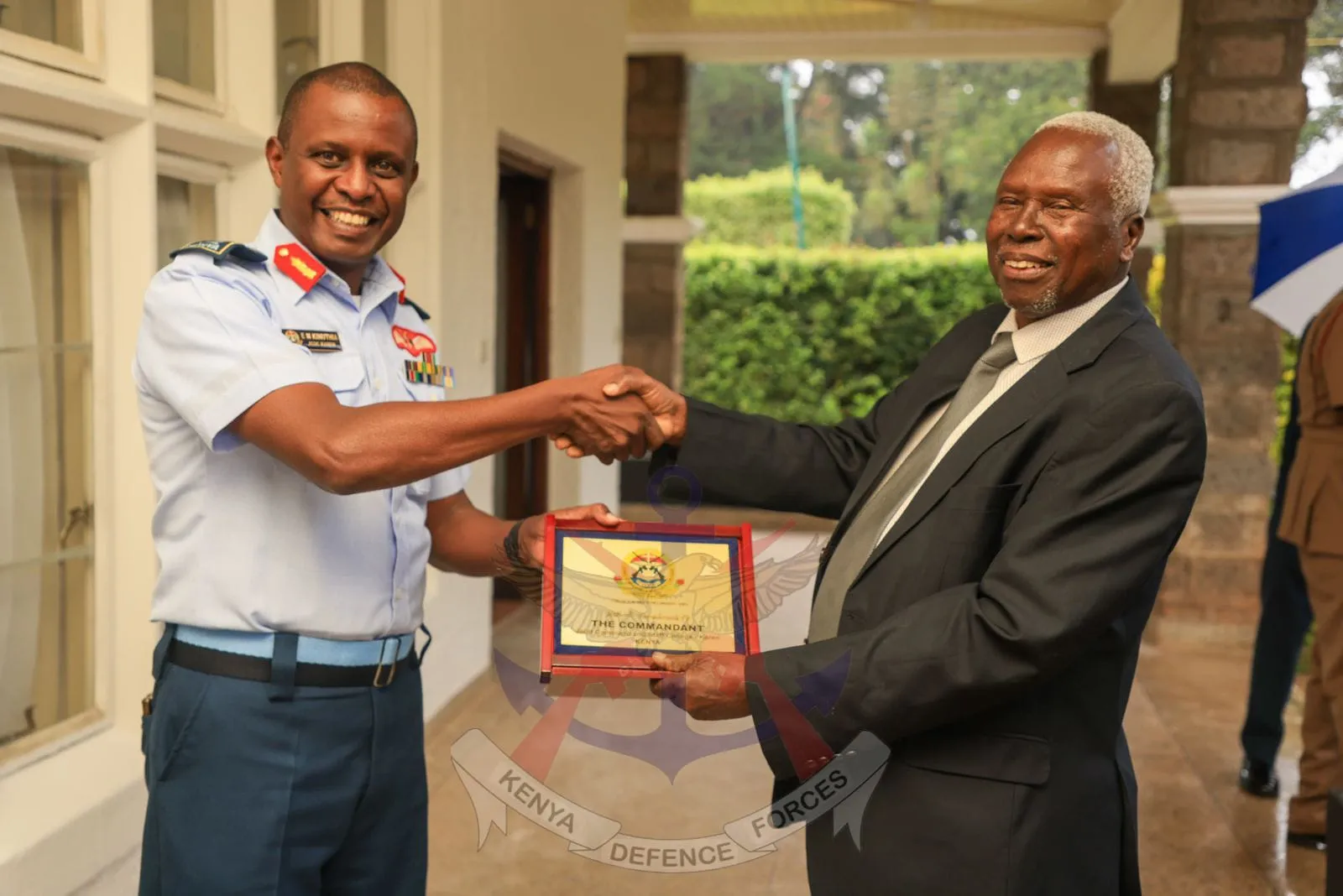
There are military commanders who command troops, generals who win battles and officers who leave behind memories.
Then there are commanders whose influence survives long after they have left the parade ground.
General (Rtd) Daudi Rerimoi Chepkonga Arap Tonje belongs to the latter category.

For many Kenyans, the name Tonje is associated with a set of military reforms that transformed the way the Kenya Defence Forces — and its predecessor, the Kenya Armed Forces — approached leadership, professional development, welfare and the place of women in uniform.
The Ministry of Defence itself describes Tonje as one of the celebrated KDF officers whose tenure produced some of the highest number of reforms aimed at professionalising the military.
But Tonje's story did not begin in the office of the Chief of General Staff.
It began in 1962, when he was enlisted into the Army and trained as a cadet at Hifford Barracks, Lanet. The Ministry of Defence records him as the first direct-entry African cadet. He was subsequently posted to the 11th Kenya African Rifles battalion.

Academic research on the Africanisation of Kenya's military places Tonje among the early generation of African officers commissioned during the transition from colonial military structures to an independent Kenyan military.
His career eventually took him to the top.
From 1996 to 2000, Tonje served as Chief of the General Staff, the position that preceded the current Chief of the Defence Forces structure. The Ministry of Defence records this period as one of particularly extensive military reform.
The Tonje Rules

Perhaps the most enduring phrase associated with his tenure is the "Tonje Rules."
But there is an important distinction.
It is sometimes popularly suggested that the Tonje Rules simply meant that the top military command would rotate cyclically among the Army, Air Force and Navy.
That description is too simplistic.
Retired Lieutenant General Humphrey Njoroge, writing about the origins of the rules, explained that the system concerned criteria governing appointments, promotions, retirement and tenure. Service commanders were subject to a maximum tenure of four years or the applicable retirement age, whichever came first.
The rationale was institutional rather than personal: senior commanders should not remain in one position long enough to become, in Njoroge's words, "individual institutions."
That distinction matters.
The rotation principle among the services has also been associated with Tonje's reforms, but the better-documented core of the Tonje Rules is the institutionalisation of tenure limits, retirement ages and structured succession.
A later analysis published by The Star specifically cautioned that the Tonje Rules should not be reduced to a simple three-service rotation formula.
In other words, Tonje's contribution was not merely about who would command.
It was also about how long they would command and how the institution would renew itself.
A military woman was also a woman
Perhaps Tonje's most socially consequential reforms involved women.
The Ministry of Defence records that during his tenure the Women's Service Corps was disbanded, leading to the integration of women into mainstream military ranks and services.
Ministry of Defence Kenya
That was more than an administrative rearrangement.
It challenged an old conception of women in uniform as belonging to a separate military stream.
The reform opened the way for women to serve alongside men within the mainstream military structure and pursue military careers on a broader basis
No comments yet. Be the first to share your thoughts.